




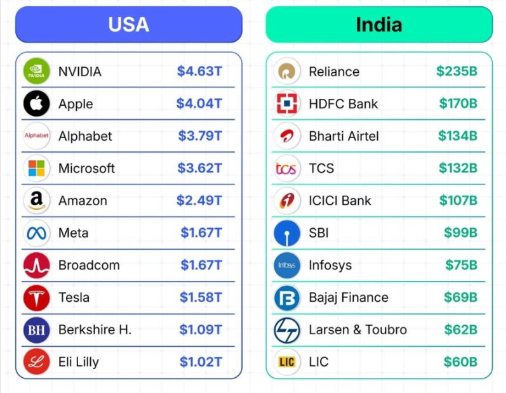
At first glance the market-cap gap between the largest U.S. and Indian companies looks overwhelming. But that gap reflects different value-creation models, not an absolute deficit in capability. The U.S. has produced many trillion-dollar firms by leveraging scalable software, proprietary intellectual property, and global platform effects. India’s largest firms, by contrast, derive outsized value from trust, distribution networks, regulatory moats, and a massive domestic market.
Key differences
-
Leverage vs. reach: U.S. winners (for example: NVIDIA, Apple, Microsoft) monetize scalable IP and platforms that can expand globally with near-zero marginal cost. Indian leaders (Reliance, HDFC Bank, TCS, SBI) monetize deep customer relationships, distribution scale and regulatory positioning within a huge domestic economy.
-
Speed of compounding: Technology-driven models compound rapidly once product-market fit and global adoption are achieved, margins and valuations can accelerate exponentially. Distribution- and trust-led models compound steadily over decades, delivering durable cash flows and resilience in regulated cycles.
-
Sector mix and capture: The U.S. top ranks are dominated by consumer tech, semiconductor, and cloud platforms. India’s top ranks favor energy, finance, telecom, and services. Sectors where network, trust, and regulation determine winners.
Why this matters for the future
The most interesting upside is hybridization: when Indian scale combines with tech-led leverage. Examples include financial services digitization, retail-to-tech plays, and platformization of traditional incumbents. As Indian firms adopt software-first strategies and export platforms, their compounding curves can shift closer to U.S.-style outcomes without losing the advantages of domestic scale.
Takeaway
This comparison should shape how founders, investors and policymakers allocate attention: recognize the structural strengths of each model, back efforts that fuse scale with technology, and measure progress by changes in compounding mechanics, not just headline market-cap numbers.


Post a comment

Chtrbox Goes Global, Picks Dubai as First Hub!
India’s publicly listed creator-economy firm Chtrbox launches its first international market in Dubai, aiming to...
Top Agtech & Foodtech Startups Shaping Future Farms!
TechCrunch highlights 14 standout agtech and food tech innovators from Disrupt Startup Battlefield, solving sustainability...
Exhausted CEOs: Leaders Running on “20% Battery”!
Calm CEO says many business leaders feel overwhelmed, mentally drained and function with low energy,...
Viral Mobile Coffee Vendor Wows Social Media!
A young coffee seller’s wearable, on-the-go brewing setup went viral online, earning praise for creativity,...