





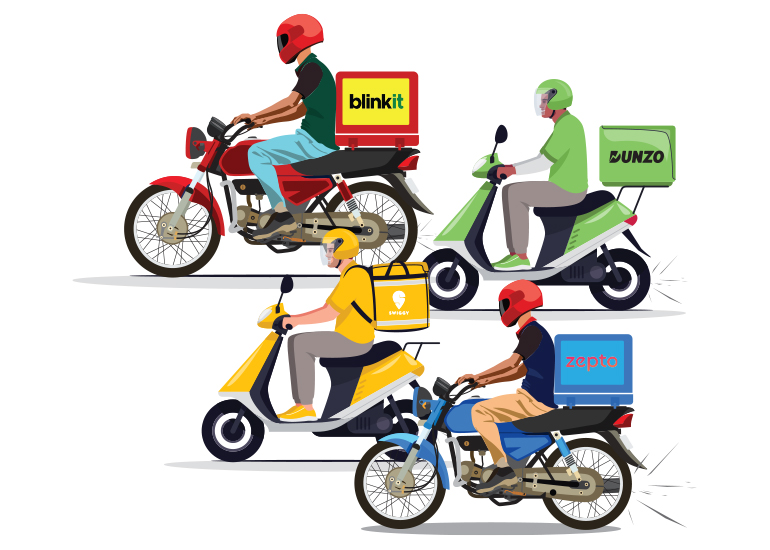
Quick commerce looks like a success story from the outside. Orders arrive in minutes, apps feel seamless, and demand keeps rising across cities. It feels like the future of retail has already arrived.
But beneath that speed, the economics are still breaking.
The biggest signal is simple. The industry is still burning massive amounts of cash. The top players have collectively burned nearly ₹9,000 crore in less than a year, even while sitting on large cash reserves.
That tells you something important. Growth is not funding itself. It is being funded.
Individually, the numbers are even sharper. Zepto’s losses jumped to over ₹3,300 crore in a single year despite strong revenue growth.
Swiggy continues to report heavy losses, with over ₹1,000 crore lost in a single quarter, largely driven by its quick commerce arm.
This is not an exception. It is the model.
At the core, quick commerce has a structural problem. Delivering low-value items in 10–15 minutes requires dense infrastructure. Dark stores, delivery riders, inventory management, and routing systems all add cost. Even after delivery fees, many orders still operate at a loss per transaction.
Then comes competition.
With players like Amazon entering and pricing aggressively, margins are getting squeezed further. Price wars in a business with already thin margins do not fix profitability. They delay it.
So why does the industry keep expanding?
Because the focus is still on scale. The assumption is that once enough users, orders, and density are achieved, the economics will improve. Fewer delivery distances, better inventory control, and higher order values are expected to eventually reduce losses.
But that “eventually” has been the story for years.
There are small signs of improvement. Some players are moving toward profitability at a unit level. But the overall system still depends heavily on external capital to sustain growth.
That creates a quiet contradiction.
Consumers see convenience. Investors see potential. But the balance sheet shows something else.
A business that is still trying to prove it can make money, Quick commerce is not collapsing, demand is real, and adoption is strong. But the idea that it has already “figured itself out” is misleading.
Right now, it is still a race, and races like this are rarely won by who grows the fastest. They are won by who stops burning cash first


Post a comment


Your Wardrobe Is Hidden Politics: Find Out Why!
Journalist Shefalee Vasudev explores how India's fashion and lifestyle choices are deeply intertwined with complex...
The Stars Have Spoken: Is Luck Yours?
Discover what the universe has planned for you today as planetary alignments shift, bringing unexpected...
From Accenture To Lakhs: This Woman Smashed It!
Gurugram entrepreneur Shruti Kundan ditched her stable corporate career at Accenture to build Boholette, a...
Seven Indian Startups Saving The Planet Right Now!
Meet the eco-warriors transforming India's future with revolutionary battery recycling, bamboo-based packaging, and air purification...