




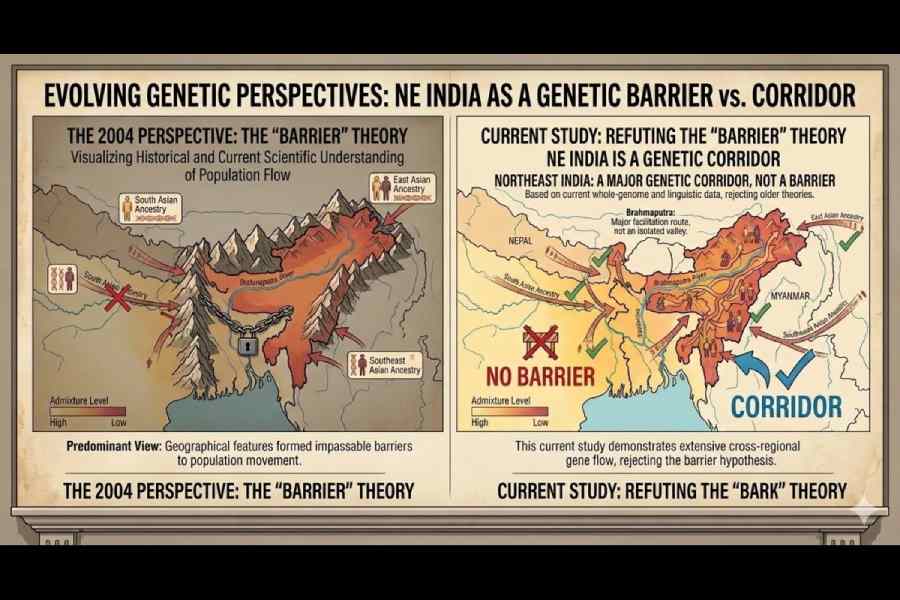
This study reshapes our understanding of the Indian subcontinent’s demographic history. Led by Professor Gyaneswer Chaubey of Banaras Hindu University (BHU) and a team of international scientists, the research analyzed whole-genome sequences to map the flow of ancient genes across one of Asia's most complex geographical terrains.
Key Findings: The Assam Corridor
The study’s most striking revelation is the high degree of genetic admixture found in the Indo-Aryan speaking populations of the Northeast.
• Ancestry Breakdown: Indo-Aryans in Assam carry approximately 76% ancestry from the Indian subcontinent and 24% from East and Southeast Asia.
• The "Corridor" Theory: Scientists argue that if the Northeast were a barrier, we would not see such significant South Asian genetic markers in the region. Instead, the data suggests a continuous "gene flow" that linked the Indian heartland with Southeast Asia.
• Melting Pot vs. Wall: "Our results compel us to rethink the role of Northeast India," noted Professor Arup Kumar Bandopadhyay of the University of Calcutta. "It was not a wall, but a thriving melting pot."
Timeline of Admixture
The researchers used high-resolution data to pinpoint exactly when these major genetic mixing events occurred.
• The Kushan Connection: The most significant admixture events are estimated to have taken place between 55 and 61 generations ago.
• Estimated Era: This corresponds to the period between 196 AD and 376 AD, a time coinciding with the influential Kushan Empire, suggesting that political and trade stability during this era may have facilitated large-scale human movement.
Why This Matters for 2026
This study is part of a broader shift in paleo-genomics that uses "living DNA" to reconstruct history where archaeological records might be thin.
1. Challenging Isolationism: It debunks the idea that Northeast Indian communities developed in total isolation from the rest of the subcontinent.
2. Health & Medicine: Understanding these unique "admixture clines" is essential for modern precision medicine in India, as certain genetic variations can influence susceptibility to specific diseases or reactions to medications.
3. Neanderthal Links: Related research recently noted that Northeast Indian populations carry some of the highest percentages of Neanderthal ancestry (up to 2.5%) in India, further highlighting the region's role as a unique genetic crossroads.

Post a comment
Your Wardrobe Is Hidden Politics: Find Out Why!
Journalist Shefalee Vasudev explores how India's fashion and lifestyle choices are deeply intertwined with complex...
The Stars Have Spoken: Is Luck Yours?
Discover what the universe has planned for you today as planetary alignments shift, bringing unexpected...
From Accenture To Lakhs: This Woman Smashed It!
Gurugram entrepreneur Shruti Kundan ditched her stable corporate career at Accenture to build Boholette, a...
Seven Indian Startups Saving The Planet Right Now!
Meet the eco-warriors transforming India's future with revolutionary battery recycling, bamboo-based packaging, and air purification...